

Part 1: The patient journey
The ultimate KPI in healthcare marketing is getting patients closer to the diagnostics and treatment they need. Roughly half of patients on chronic therapies don’t take them as prescribed, a gap linked to an estimated 125,000 preventable deaths and hundreds of billions in cost every year (Duke Health). When the right message reaches the right person at the right moment, it’s a win toward the advancement of medicine and humanity, not just a cell in a reporting spreadsheet.
For healthcare marketers, the challenge is to understand where the journey is breaking, how to compete in a complex market, and where budget is being wasted. Those questions can't be answered by clinical data or behavioral data alone, and require a connected view of the human experience.
In this series, Treating the human experience, we explore how MiQ helps answer those questions with intelligence that drives action. Our first installment follows the patient. Part 2 follows the physician, and Part 3 is where the two meet.
The patient journey starts long before diagnosis
You may imagine the patient journey as a straight line: symptom, search, doctor, diagnosis, prescription, treatment. The reality is far less linear. People move fluidly between self-treating, delaying care, researching options, and switching. No patient experiences a condition in exactly the same way.
To decode the patient journey, marketers need to look beyond what happens inside the doctor’s office. Long before someone appears in a claims record, their everyday behaviors — what they watch, browse, buy, search, and where they go— can signal their current stage in a condition and where they’re headed. That is where the clinical and human sides of healthcare come together.
Claims can show what happened. Behavioral signals can help illuminate the context around it. Together, they create a more unified view of the patient journey: not a diagnosis reduced to a data point, but a person moving through uncertainty, decisions, barriers, and care.
This gives healthcare marketers a far more holistic and humanized view of the market. That holistic view gives us tremendous insight into how and why the patient journey may break. Let’s dive in.
Gaps in the journey — stage by stage
Patients don’t leak all at once. From a 30,000-foot view, there are three distinct points where the journey commonly breaks, and each calls for a different response.
1. The gap between diagnosed and prescribed patients is often the largest and most misunderstood.
With most conditions, only a small share of diagnosed patients are taking a given brand; others may be using older therapies, going untreated, or remaining undiagnosed in practice. This drop-off actually presents a white space that can reveal whether the barrier is awareness, education, access, or something else entirely.
With MiQ’s Patient Journey Funnel, marketers can see the estimated reach of that population, understand where the opportunity exists, add the segment to their targeting strategy, and immediately activate those patients directly.
The goal is recognizing that different patients need different kinds of support as they move from diagnosis toward a treatment decision.
2. The gap between prescribed and picked up is almost entirely non-clinical.
There’s a disconnect between a script being written and a patient picking up their orange bottle. Copay shock, prior authorization delays, specialty pharmacy confusion, and payer coverage can all stand between a prescription and a fill. This is where clinical intent meets the practical reality of a person’s life. Awareness without access is wasted spend, and, more importantly, can leave patients without the care their provider intended.
A smarter strategy starts by understanding where access is strongest and prioritizing markets with favorable coverage, while providing more targeted support where barriers are higher.
We take it a step further by identifying patients who were prescribed a medication but never filled it, turning a drop-off point into an actionable audience.
Teams can reach these patients—and competitors’ non-filled patients—with timely messaging designed to address barriers such as cost, coverage, and access, all tailored to the human being behind the prescription.
3. The gap between filling a prescription and staying on therapy is one of the most preventable losses in healthcare.
The journey doesn’t end when a patient fills a prescription.
Many patients fill once, and then fall off treatment, often due to non-clinical barriers. The critical inflection point is the six-month persistence cliff, making the weeks leading up to it a powerful window to deliver timely, relevant support. Because adherence can vary by dispensing channel, pharmacy data can help identify where refill reminders and where patient-support messaging is most critical.
The opportunity isn’t just to remind people to refill, but rather understand when and where support is most needed, and connect that support to the patient’s broader experience.
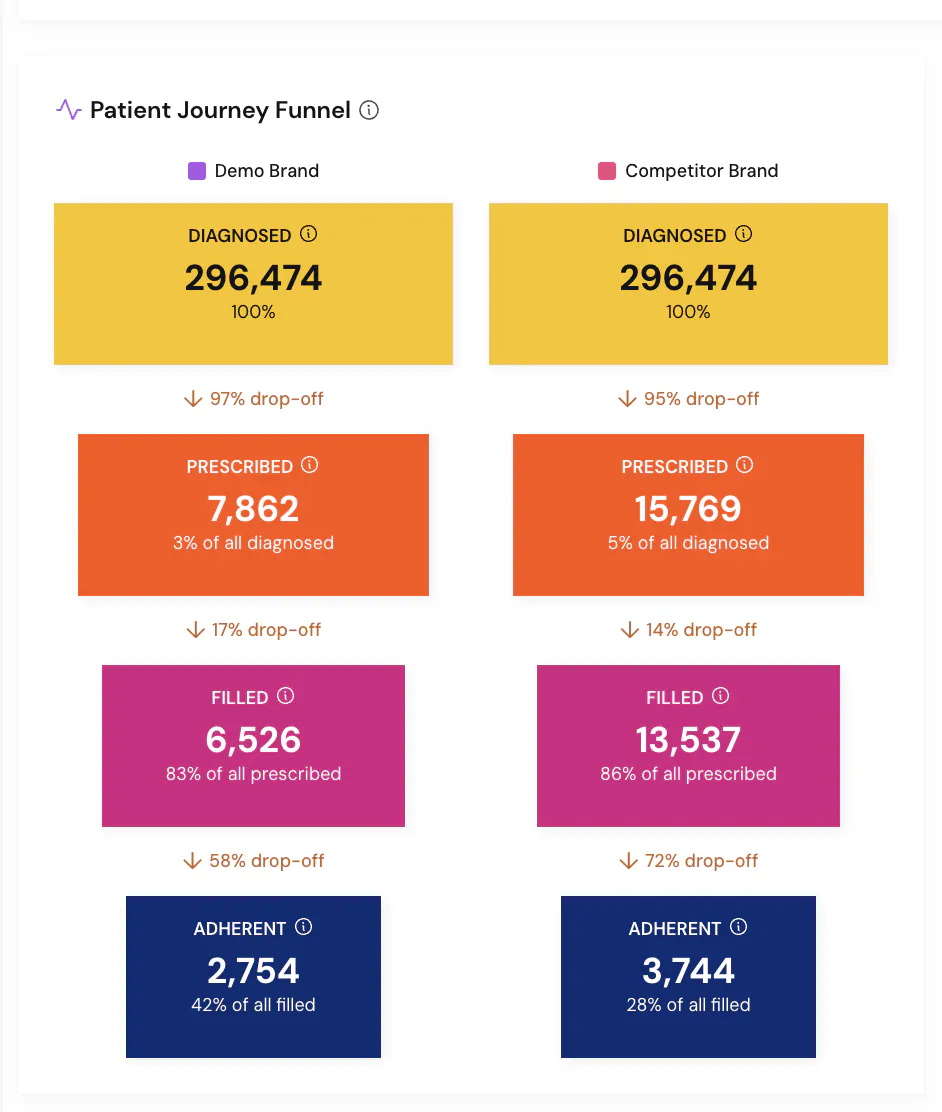
Illustrative MiQ Healthcare Intelligence view — whitelabeled. Sample data shown for illustration only.
From understanding to activation
Insights are only as valuable as how you can act on them. When a brand has a holistic view of the patient journey, they’re able to align creative to real needs, time it within critical decision-making windows, and maintain top of mind well past diagnosis.
The patient journey is too complex, and too critical, to be registered through siloed and unactionable data. MiQ’s Healthcare Intelligence brings those signals together in one connected view, harmonizing claims, pharmacy, behavioral, and media data so healthcare marketers can identify patients at the moments that matter and activate those insights across platforms, without being tied to a single DSP, all in the interest of getting people the care they need.
For more information on MiQ’s Healthcare solutions, please contact us.