

From my past two years at MiQ, I've seen the beginnings and ends of many campaign lifecycles, so below is my attempt at pulling back the curtain to shine the spotlight on the magic behind the glamor of programmatic media.
What is a programmatic advertising campaign?
Simply put, it's how a brand gets its adverts in front of potential customers in online environments, like a desktop screen or a mobile device, but also on TVs, games consoles, and digital billboards. Before a trader like me starts a campaign, there are specific parameters to be agreed on with the client to determine things like who to target (audience), the different channels (environment), the length of the campaign (flight time) and the KPIs (targets/goals).
At their core, campaigns are run in order to achieve a goal. For travel clients, it may be bookings or ticket purchases. For clothing, it can be more purchases of their products or awareness of their newly launched range. Every client is different and measures success differently.
That's where traders like me come in. We provide guidance on how to apply their targets and what the different methods are that we can use to optimize their campaign to hit (or even exceed) those targets. And almost always the answer can be found in data. Vast amounts of it. And while the quantity of data we work with can seem intimidating, it's the most exciting part of running these campaigns.
Before delving further, let's provide some context on what a traditional campaign lifecycle looks like.
The lifecycle of a programmatic campaign
- Brief – The client gives our sales team their campaign parameters, KPIs and target audience.
- Recommendation – We provide our recommendations back to the client and outline a strategy that we think will best deliver the budget against the goals, including audience segmentation, creative asset preparation and planning around reaching specific audiences before launch.
- Approval/launch – After some back and forth, tweaking and refining the strategy, the client hits the approve button, and it's time to go live.
- Execution – As the campaign runs, we optimize it to improve performance, refining geographical and behavioral targeting to improve ad relevance for potential customers, and providing updates to clients on what's working, what we're changing and why.
- Campaign wrap-up – Once the campaign is finished, we put all the results in an end of campaign (EOC) report.
- Follow ups – Beyond the headline KPIs, we also provide an in-depth insight report providing analytics on campaign, audience and pixel performance to help improve future ad campaigns.
Who works on what across the campaign lifecycle?
The initial brief and recommendation stages are led by sales and/or account management, with the aid of technical expertise from operations (i.e. traders, product managers and analysts) to make sure we're aligned with client goals, and we've got what we need to deliver the right results. As much as our sales teams sometimes wish the sky was the limit with what we can do, operations are there to gently guide them back down to Earth with concrete facts on how to best execute campaigns. And the product team will usually be on hand for brainstorming sessions to think of ways we can do new things, both now and in future planning.
The middle part of the campaign – approval/launch, execution and campaign wrap-up - are where the trader takes the reins. They're the ones who will implement the strategy and optimize it based on the data generated throughout the campaign, or by using existing CRM/site data. During this stage, communication with clients via weekly reporting is important for visibility and opening up the conversation on performance.
One of the most important parts of our job is creating a story and verbalizing the data we're getting in words that resonate with our clients. A lot of the time, clients don't want to see numbers and data via percentages and decimal points. They want to hear the unspoken bits between the data and find the nuggets of information that they can use to drive their marketing objectives to the right consumer.
The last stage of the process is follow ups. In many ways, this is the most important bit, especially at MiQ, because you get all the post-campaign insight reports, showcasing the story behind the campaign. It's the culmination of all the weekly reports, but with stronger and deeper analytics. These insights are then used to fuel the next campaign, to make sure it performs even better.
How does a programmatic campaign actually happen?
So, that's what a programmatic campaign looks like from a client perspective. But what's going on under the hood?
When we're completing the first two steps of the campaign lifecycle, that's the process of building out the tactical recommendations so traders can start setting up the campaign in the DSP (Demand Side Platform) That's the platform you use to buy ad inventory across websites, mobile apps, and other digital space. Demand side platforms connect to ad exchanges, which are online marketplaces where available ad space and digital ad inventory are bought and sold.
Then with real-time bidding (RTB), bid requests are sent for each ad impression, advertisers bid in real time, and the highest bidder wins the ad slots in milliseconds. An example of a basic recommendation for digital campaigns looks something like this:
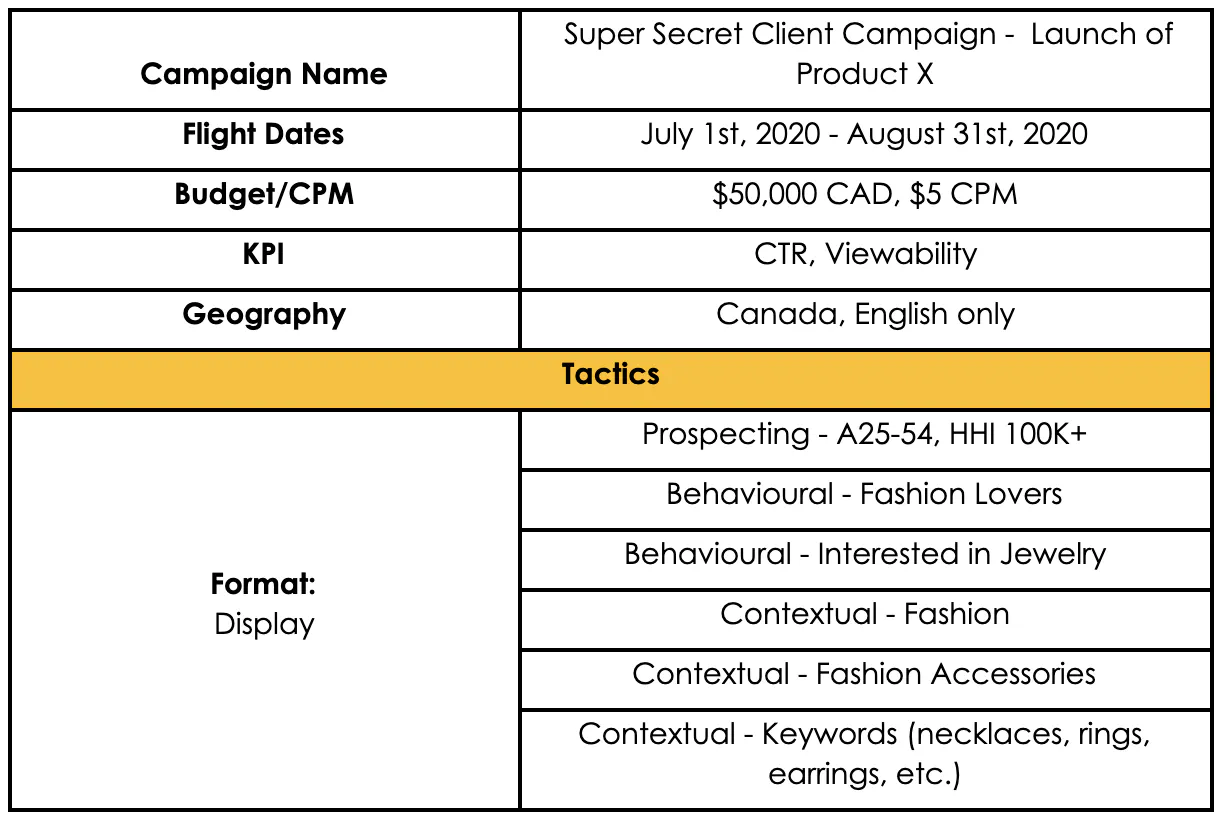
And here's what all those words and acronyms mean:
KPI: Key Performance Indicator, i.e. the goal of the campaign
Impressions: the number of times an ad appears online
CPM: Cost per mille (1000) impressions, i.e. the price of delivering 1000 ad impressions
CTR: Click-through rate, i.e. the percentage of users that click on an ad
Viewability: how visible the ads are online, i.e. where they are on a page
Prospecting: broad targeting used to generate mass awareness
Behavioral: targeting based on user online browsing behaviours derived from 1st, 2nd and 3rd party data
Contextual: targeting sites and web pages based on the content on them.
What do traders do on a programmatic campaign?
The initial set up is fairly easy, as it's based on the campaign structure approved at the recommendation stage. That said, our traders follow some specific rules to make sure we're set up for success:
- We run all our tactics as separate line items so we can assess performance independently and optimize towards the best performing tactics.
- Unless specific strategy budgets are required (i.e. spend $10,000 against the Contextual – Fashion strategy), keeping budget fluid among all the tactics is great so we can optimize without limits and keep all our options open for shifting budgets when required.
- We adjust our CPMs as needed and keep them fluid. Reaching a broad audience is usually cheaper than targeting more specific users, so audience size and bidding strategy both shape programmatic advertising cost. You wouldn't want to pay the same CPM for both those users.
- Unless your campaign strategy requires you to run in multiple DSPs, we find it's best to hone in on one DSP so you can manage frequency and minimize the workload of hopping from platform to platform.
What about programmatic performance and campaign optimization?
After the campaign has launched, it's important we're hyper aware of performance and pacing. Through optimizations (analyzing data and making changes based on what it tells us), we're able to make decisions based on how to deliver the campaign effectively within the parameters of the recommendation.
These are a few of the things we consider when making optimizations:
- Look at the impact of your optimizations. If we're removing an aspect of targeting, we need to make sure it won't impact how many people we can reach. We want to make sure we're performing well but we also need to deliver the campaign budget in full.
- Consider how quickly you are making changes. If we're continually making changes to a campaign, daily or even multiple times a day, we won't ever understand the impact of those changes as they don't have time to show what they can do. It's sometimes hard for traders but sometimes it pays to wait and see.
- Make sure there's enough data behind your decision. If we're removing a targeting element from a campaign, we make sure we do this with enough data behind the decision and with the understanding that it could hinder our overall campaign performance/pacing. For a two month campaign, wanting to remove certain inventory sources or creatives from the rotation based on two days worth of data isn't giving the campaign enough time to generate significant data to be the basis of a smart decision.
- Scale what works. Creating new line items in the DSP is a great way to hone in on top performing targeting without having to worry about affecting scale. Start off with a small budget and spend more against it when you see success.
It sounds complicated – is it?
Honestly, yes and no. Compared with traditional advertising and traditional media buying, it’s far more automated than manual buying, even if the ecosystem itself can still be complex. And some campaigns are very easy to set up and run.
That’s one of the benefits of programmatic: programmatic ads can scale across multiple platforms and channels more efficiently than traditional media buying, making online advertising easier to manage and optimize.
However, the campaigns that have traders and teams working hard together, brainstorming and testing strategies or new products, tend to be the ones that stand the test of time. Everyone always looks back at those campaigns and speaks about the work and collaboration and pure will to get a campaign to perform. Those are my personal favourites and I bring them up often to anyone that will listen (or is forced to listen to my ramblings in meetings).
Our CEO in Canada always comments on the fact that he loves to see all the departments huddled around a whiteboard, maybe fighting for the marker, working to come up with solutions together. That's the stuff that makes a campaign more than just a one-off media execution: it becomes a challenge to see beyond the surface level and understand how to get to the bottom of genuine business challenges.
Ready to take your programmatic to the Nth degree? Discover MiQ Sigma.