

The way we browse online has changed. We’ve become more focused, more intentional, and more aware of the impact of ‘doomscrolling’. Younger consumers are seeking out more intimate online communities, and Google’s AI search summaries on the results page have allowed us to get the answers we’re looking for even quicker than before.
By spending less time wandering in cyberspace and more time seeking out exactly what we’re looking for, how do consumers discover things organically? Well, scrolling is still a popular activity and, where discovery does happen, it’s likely through curated feeds and groups, or heavily influenced by the algorithm. Consumers will still spend multiple hours per day scrolling through content (usually on social media). And, unsurprisingly, younger consumers are the most susceptible to dopamine-driven doomscrolling.

Unlock watching browsing and buying.
How often are we browsing?
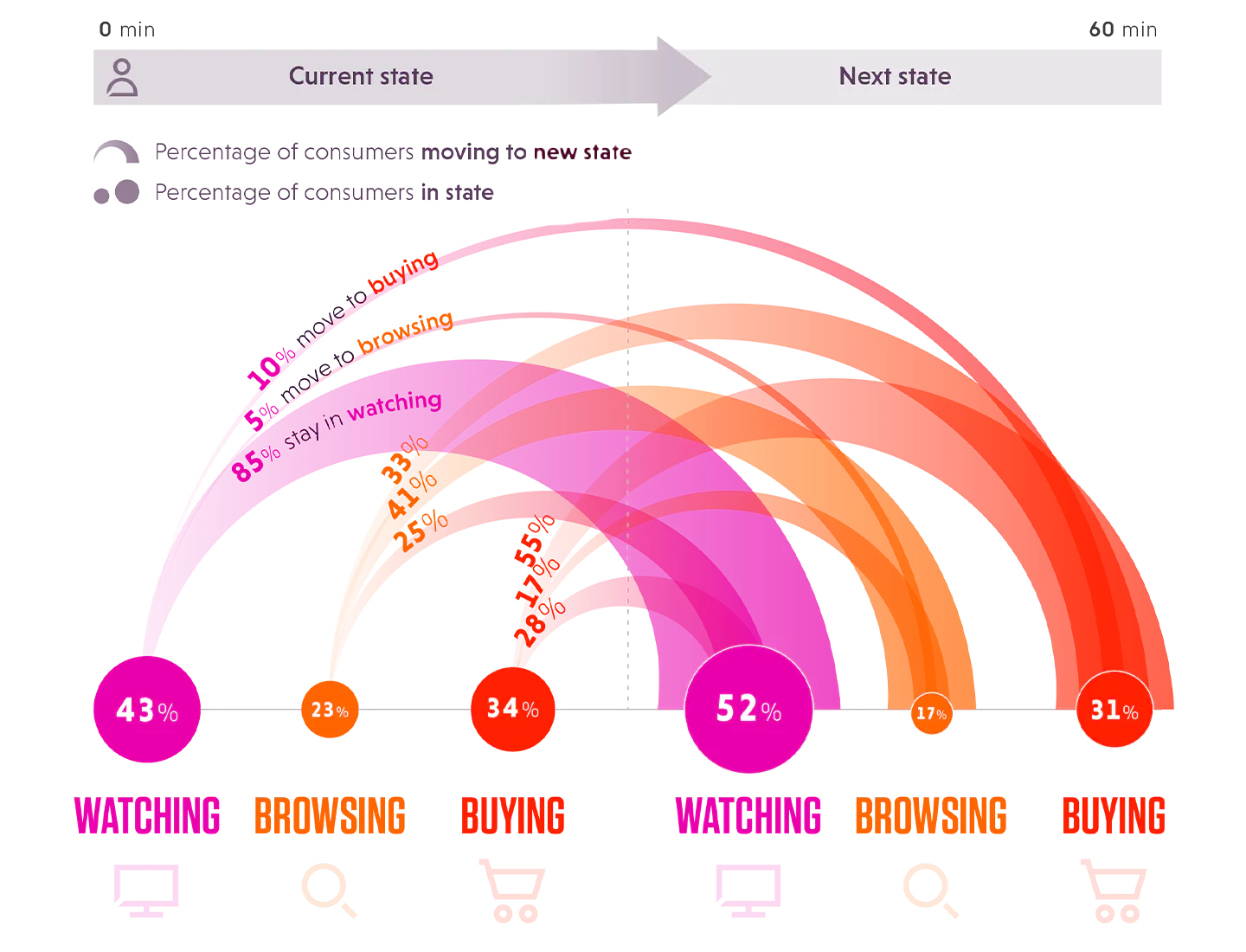
According to our ‘From funnel to flexibility’ report, consumers spend about one quarter of their time online browsing. And, within any given hour, 25% will move to watching content, and one third will shift to making a purchase. Although browsing is an active state, often driven by a goal, it’s also the state consumers are most likely to leave. However, it’s also when consumers are the most receptive to advertising.
91% of consumers use a second device to browse the internet while they’re watching something, with the most common activities being scrolling through social media, reading the news, or watching short-form videos.
The impact of AI on search
Old habits die hard. Google is still the default starting point for a purchase or research. But the rise of generative AI for search has the power to change that. Consumers can now receive faster, more direct answers from AI chatbots and AI generated overviews, which can reduce traffic to websites and lead to most users ending a search before clicking through at all. Plus, these AI search overviews will usually take their content from sources like Wikipedia, YouTube and Reddit, funneling consumers back towards these larger platforms.
The result is a double-edged sword. While consumers who click through to those websites are likely to be more engaged, the sharp drop-off in general browsing and consumer traffic generally means fewer opportunities for advertisers to reach people outside of Google.
And as more adults become comfortable with large language models (LLMs), they’re also becoming more comfortable using tools like ChatGPT for product research and purchases. Nearly half (44%) of consumers say they’ve used a tool like ChatGPT or Gemini when shopping, either to compare products and brands, summarize reviews, ask for gift ideas, or make recommendations. Of course, this is even higher among younger consumers. One in four have used AI to help write a difficult message, like a breakup text or resignation, and about as many plan to use AI shopping assistants in the next year.
Using AI to search in this way makes it much more active than the usual browsing state, but not quite traditional buying. As people continue to use AI for search more and more, LLMs will likely become an even more vital channel for advertisers.
But, with fewer people spending time doomscrolling and generally browsing online, advertisers are facing a challenge. They need to make the most of the opportunities they have to reach every consumer. And this means adopting a cross-device strategy to reach people across multiple devices as they switch between watching, browsing and buying. And this is where having AI-powered adtech can really come in handy.
How MiQ Sigma can decode browsing
MiQ Sigma makes planning and executing media plans a breeze with the latest advanced AI models, and backed by a Data Spine of more than 700 trillion data signals. Sigma unifies your data, media and platforms to better understand your audience as they go along the new consumer journey. That means you can make faster, more customized decisions about your media buys to really achieve your campaign goals.


